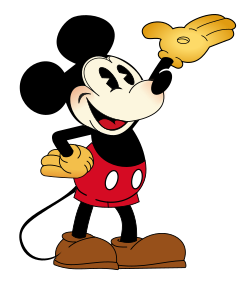
 Everyone knows Mickey Mouse. If you have ever heard of Disney, then you know Mickey. The two are synonymous with each other. First appearing in the 1928 short Steamboat Willie, the cheerful mouse in red shorts and white gloves grew from a scrappy silent-film gag into a global icon, a theme park mascot, and the corporate symbol of a large entertainment company, maybe even the biggest one on earth. He has starred in shorts, features, comics, and video games for nearly a century, and in 2024 his earliest version did something almost no Disney property ever does. It entered the public domain.
Who Is Mickey Mouse?
Mickey Mouse is an anthropomorphic mouse created by Walt Disney and animator Ub Iwerks in 1928. Cheerful, curious, and endlessly optimistic, the modern Mickey is the friendly everyman at the center of the Disney brand, hosting theme parks, fronting merchandise, and appearing as the company's official mascot. His round ears, white gloves, red shorts, and high voice are recognized almost everywhere on the planet. What began as a single cartoon character became the foundation of an entertainment giant, to the point that Walt Disney himself often said the whole thing started with a mouse.
Mickey Mouse's Origin and Steamboat Willie
Mickey's story starts with a loss. Walt Disney had been producing a character called Oswald the Lucky Rabbit, but lost the rights to his distributor, and needed a new star fast. I never even knew about Oswald until playing Epic Mickey. Working with Ub Iwerks, who designed the character, Disney created Mickey Mouse as the replacement. Mickey's breakout was Steamboat Willie, released in November 1928, one of the first cartoons with fully synchronized sound. The short, where Mickey pilots a riverboat and turns the animals aboard into an impromptu band, was a sensation, and the combination of sound and personality made Mickey an overnight success. Two earlier shorts, Plane Crazy and The Gallopin' Gaucho, had been made first but struggled to find distribution, so Steamboat Willie became the debut that mattered.
How Mickey Mouse Changed Over Time
The Mickey of Steamboat Willie is not quite the Mickey people picture today. The original is rubbery, mischievous, and a little rough, a rascal who torments barnyard animals for laughs, with simple pie-cut eyes and no real dialogue. Over the decades Disney softened and refined him. He got pupils, a rounder and friendlier design, gloves, color, and eventually a speaking voice. By the time he reached the modern era he had shifted from a trickster into the wholesome, welcoming figure who represents the company. That evolution matters legally as well as visually, because it is the reason Disney still controls the Mickey most people know while the earliest version has slipped from its grasp.
Mickey Mouse and the Public Domain
On January 1, 2024, the copyright on Steamboat Willie expired, and the earliest version of Mickey Mouse entered the United States public domain after 95 years. This was a historic moment, since Disney had spent decades lobbying to extend copyright terms, to the point that a 1998 law was nicknamed the Mickey Mouse Protection Act. When the day finally came, creators were free to use the 1928 Steamboat Willie Mickey in their own work.
The catch is that only that specific early version is free. Every later, more familiar version of Mickey remains under copyright, so the red shorts, the modern design, the pupils, and the recognizable voice are all still protected. On top of that, the name Mickey Mouse and the character's image are trademarks, and trademarks do not expire the way copyrights do. That means creators can use the Steamboat Willie Mickey but cannot use him in a way that suggests their product comes from Disney. It is a narrow opening, not open season.
The Steamboat Willie Horror Movies and Games
Almost the moment Mickey entered the public domain, creators rushed to do exactly the kind of thing Disney would never allow. Multiple horror projects using the Steamboat Willie design appeared within days of January 1, 2024, including slasher films and a cooperative survival horror video game built around hunting a murderous version of the mouse. This mirrored what happened to Winnie the Pooh, whose public domain arrival produced the horror film Winnie the Pooh: Blood and Honey. Turning a wholesome childhood icon into a horror villain is the obvious first move for public domain shock value, and Mickey got the same treatment. These projects can only use the rougher 1928 version, not the modern Mickey, but the black and white boat captain is more than creepy enough to work in a horror setting.
Mickey Mouse in Video Games
Mickey has been a video game star for decades, often in surprisingly good games. He headlined Sega Genesis classics like Castle of Illusion, a beloved platformer that still holds up, and its follow-ups. His most interesting modern role to me is in Epic Mickey, the Wii game that leaned directly into his history, casting him in a dark, forgotten cartoon world alongside Oswald the Lucky Rabbit, the very character Walt lost before creating Mickey. He is also a central figure in the Kingdom Hearts series, where King Mickey wields a Keyblade and fights alongside Sora, Donald, and Goofy against the darkness. For a company mascot, Mickey has had a strong run in games.
Who Voices Mickey Mouse?
Mickey's famous falsetto has been provided by only a handful of people across his entire history. Walt Disney himself voiced Mickey for the first two decades, giving the character his original squeaky delivery. Sound effects artist Jimmy MacDonald took over in 1947 and voiced him for decades after. Wayne Allwine then held the role from 1977 until his death in 2009, and became closely identified with the character. Since 2009, Bret Iwan has been the official voice of Mickey Mouse. It is a short list for a character who has been around nearly a hundred years, which speaks to how carefully Disney has guarded the role.
Mickey Mouse endures because he is bigger than any one cartoon. He is the mouse that built a company, the mascot of an empire, and now, in his earliest form, a character the public finally gets to play with. Whether he is whistling on a steamboat in 1928, swinging a Keyblade in Kingdom Hearts, or starring in some strange public domain horror film Walt never could have imagined, Mickey remains the character animation itself is built on.
