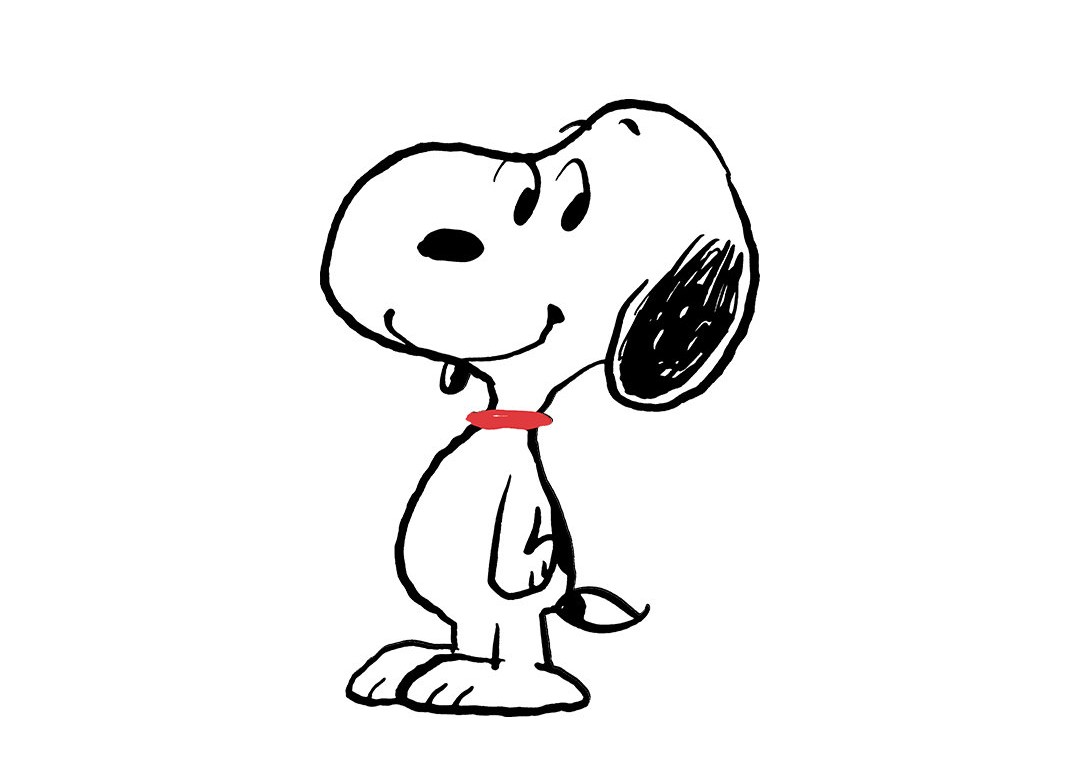
Snoopy is the most famous beagle in comics, and maybe the most famous beagle anywhere. He is the breakout star of Charles M. Schulz's Peanuts, a dog who started as Charlie Brown's quiet pet in 1950 and grew into the most recognizable character in the entire strip. Playful, stubborn, and endlessly creative, Snoopy spends his days turning an ordinary doghouse into a stage for whatever he imagines himself to be, and he stole the spotlight so completely that plenty of people know him without ever having read a single Peanuts strip.
Who Is Snoopy?
Snoopy is defined by his imagination. He spends most of his time lying on top of his red doghouse, using it as a launchpad for elaborate fantasies where he is anyone but a normal dog. One day he is the World War I Flying Ace, the next he is Joe Cool leaning against a wall on a college campus, and the doghouse becomes a Sopwith Camel, a writer's studio, or whatever the daydream requires. Those personas are how Snoopy escapes the limits of being a pet and becomes the star of his own inner world.
Underneath all of that, Snoopy is loyal and affectionate. He frustrates Charlie Brown constantly with his independence and his refusal to act like an ordinary dog, but he always comes back to him in the end. His humor comes from that mix of aloofness and sudden bursts of personality, the way a dog lying perfectly still on a doghouse roof can somehow be the most dramatic character on the page.
Snoopy the World War I Flying Ace and the Red Baron
Snoopy's most famous alter ego is the World War I Flying Ace, and it is the one that defined him for generations. In this fantasy, Snoopy dons a flight helmet, scarf, and goggles, climbs atop his doghouse, and imagines it as a Sopwith Camel fighter plane locked in a dogfight with his eternal enemy, the Red Baron. He never actually catches the Baron, and that is the joke. The Flying Ace is always shot down, always crashing behind enemy lines, always trudging through the French countryside in search of a way home. It is heroic fantasy filtered through the same gentle failure that defines Charlie Brown, and it became so iconic it inspired everything from a hit novelty song to the naming of theme park areas.
Why Doesn't Snoopy Talk?
One of the quiet rules of Peanuts is that Snoopy never speaks out loud. He communicates entirely through thought balloons, physical comedy, and that expressive face, but the human characters cannot hear his thoughts the way readers can. This is a big part of why Snoopy works. He is the funniest, most opinionated character in the strip, and yet everyone around him only sees a dog. That gap between what Snoopy is thinking and what Charlie Brown actually perceives is the engine behind a huge amount of the comedy. When Snoopy did get a voice in animated specials, it was through sound effects and vocalizations rather than dialogue, keeping him wordless even on screen.
Snoopy's Relationships
Charlie Brown: Snoopy's owner, the boy who feeds him and loves him even though his dog's larger-than-life personality constantly overshadows him.
Woodstock: Snoopy's best friend, a small yellow bird who is his loyal sidekick, confidant, and partner in most of his schemes and adventures.
The Peanuts gang: Snoopy weaves in and out of the lives of Lucy, Linus, Peppermint Patty, Sally, and the rest, usually as comic relief or a foil to their childhood anxieties.
These relationships highlight Snoopy's role as both companion and comic spark. He is part of the group but always slightly apart, living in his own imaginative world while the kids around him work through their very human worries.
Snoopy in Peanuts
Across the Peanuts run, Snoopy evolved from a background pet who walked on four legs into the upright, scheming, fantasizing mascot of the whole franchise. His daydreams gave the strip its variety and much of its humor, while his bond with Charlie Brown kept him grounded in something real. Over 50 years he became the character most associated with Peanuts, the face on the merchandise, the balloon in the parade, and the star of the specials. There is a long-running debate among fans and critics about whether Charlie Brown or Snoopy is the true center of Peanuts, and the fact that the dog is even in that conversation says everything about how far the character traveled.
Snoopy in Adaptations
Snoopy has appeared in countless TV specials, films, and stage productions. From A Charlie Brown Christmas in 1965 to The Peanuts Movie in 2015 to the Apple TV Plus series that keep the characters alive for new kids, he remains the most recognizable face of the franchise, quite possibly more recognizable than Charlie Brown himself. His Flying Ace persona shows up constantly in animation, video games, and theme park attractions, and his silhouette alone is enough for most people to know exactly who he is. Few comic characters have made the jump across that many formats while staying so clearly themselves.
Who Created and Drew Snoopy?
Snoopy, like every Peanuts character, was created by Charles M. Schulz, who wrote and drew the strip himself for its entire run. That detail matters more than it might sound. Schulz personally drew nearly 18,000 Peanuts strips over almost 50 years, never handing the art off to a studio or a team, and he made sure the strip would end with him. The last daily Peanuts ran on January 3, 2000, and the final Sunday strip ran on February 13, 2000, the day after Schulz died. There would be no new Snoopy adventures drawn by anyone else, because Schulz did not want them. Everything Snoopy is came from one man's hand.
Why Snoopy Endures
Snoopy endures because he turned an ordinary life into an extraordinary one through pure imagination, and he did it as a dog who never said a word. He is funny, loyal, and creative, and he proved that the smallest stage, a doghouse roof, was enough to be anything.
Snoopy not showing up once a week is the only reason I miss newspapers. It was great getting the paper and reading the Funnies, and no paper means no Peanuts. I know the actual strip ended in 2000, and I know it lives on in reruns and specials, but there was something about turning to the comics page and finding that beagle on top of his doghouse, mid-daydream, that a phone screen has never quite replaced. That is the version of Snoopy that stuck with me, and it is why he still feels like the most alive character Schulz ever drew.
