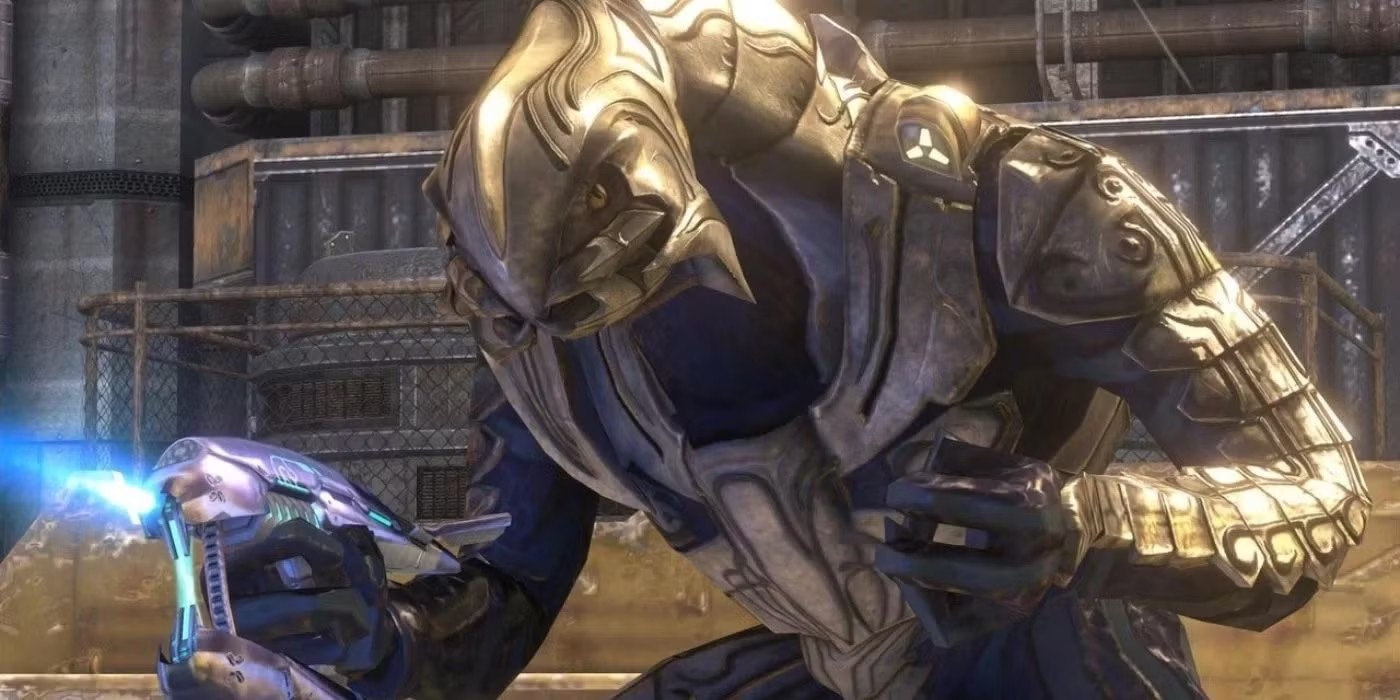
The Arbiter is one of the most important characters in the Halo series, and the rare enemy who becomes a hero without it ever feeling cheap. Introduced as a playable character in Halo 2 in 2004, he is a Sangheili warrior named Thel ‘Vadam, a proud commander disgraced by failure and handed a suicide mission to redeem himself. What happens instead is that he uncovers the biggest lie at the center of the Covenant, and turns his blade on the empire he spent his whole life serving. For a character who starts out fighting Master Chief, he ends up one of humanity’s most crucial allies.
Who Is the Arbiter?
The Arbiter is not a single person so much as a title, one carried by different Sangheili across Covenant history. The rank of Arbiter is handed to a disgraced Elite as both a punishment and an honor, a chance to die gloriously in service of the Covenant and wipe away their shame. Historically it has been a death sentence dressed up as a reward. The Arbiter that the games follow is Thel ‘Vadam, once known as Thel ‘Vadamee, and he is the one who breaks that pattern by surviving long enough to learn the truth about what he serves.
The Arbiter’s Origin
Thel ‘Vadam’s fall is what makes his story work. He was a Supreme Commander in the Covenant fleet, one of their most respected leaders, until Master Chief destroyed the first Halo ring on his watch in Halo: Combat Evolved. In the eyes of the Covenant, allowing a sacred ring to be destroyed was an unforgivable heresy, and Thel was branded, tortured, and nearly executed for it. Instead, the Prophets offered him the rank of Arbiter, sending him on missions no one was expected to survive. He took it, because to a Sangheili of his faith, dying for the Covenant was better than living in disgrace.
The Arbiter in Halo 2
Halo 2 splits its campaign between Master Chief and the Arbiter, and the Arbiter’s half is where the series’ mythology cracks wide open. Sent to hunt down a heretic leader, he slowly discovers that the Great Journey, the religious promise that firing the Halo rings will lift the Covenant to godhood, is a lie. The rings are not salvation. They are weapons built to wipe out all life in the galaxy to starve the Flood. When the Prophet of Truth orders the Brutes to slaughter the Sangheili in an event known as the Great Schism, the Arbiter’s loyalty finally shatters, and he allies with the humans he was raised to exterminate. Getting pulled away from Master Chief to play as an alien annoyed me at launch, right up until it became obvious the Arbiter had the better story.
Is the Arbiter a Good Guy?
This is the question a lot of players ask, and the answer is yes, though he does not start that way. When the Arbiter is first introduced, he is fighting for the Covenant and hunting humanity, which makes him an enemy. His turn is not a sudden switch either. It is the slow, painful realization that everything he believed was a manipulation, and that the Prophets he served were willing to butcher his entire species to keep the lie alive. By Halo 3 he is fighting side by side with Master Chief against the same Covenant he once commanded. He is a good guy by the end, but the reason he lands is that he earns it across two full games rather than flipping in a cutscene.
The Arbiter and Master Chief
The relationship between the Arbiter and Master Chief is built on the strangest foundation possible, since they spend the first game and a half trying to kill each other. What brings them together is a shared enemy and a grudging respect. By Halo 3 they fight as genuine allies, and the game leans into the odd partnership between a human super soldier and the alien warrior who once led fleets against him. The Arbiter is there at the end of the war, and he is one of the few who does not give up on Chief when the Master Chief is left drifting in space. Watching two former enemies end up trusting each other completely is a big part of why Halo 3’s ending hits as hard as it does.
The Arbiter After the War
Thel ‘Vadam’s story does not end with the Covenant war. After the fighting, he returns to the Sangheili homeworld of Sanghelios and becomes the leader of the Swords of Sanghelios, a faction working to rebuild his people and break them away from the old religion for good. He returns in Halo 5: Guardians, allied with humanity once again and fighting on his homeworld alongside the Spartans. He has gone from a disgraced commander to the closest thing his species has to a unifying leader, which is a long way to travel for a character who started as a boss fight.
The Arbiter in Halo Wars
It is worth clearing up one point of confusion. The Arbiter in Halo Wars is not Thel ‘Vadam. That game, a prequel set decades earlier, features a different Arbiter named Ripa ‘Moramee, who is very much a villain and serves the Covenant loyally. Because the rank passes between different Sangheili over time, more than one character has carried the title, but when most people talk about the Arbiter, they mean Thel ‘Vadam from the mainline games.
Who Voices the Arbiter?
The Arbiter is voiced by Keith David, the veteran actor known for his deep, commanding voice across film, television, and games. David gives Thel ‘Vadam a weight and dignity that sells the entire arc, from wounded pride to righteous fury to hard-won honor. It is one of the best pieces of voice acting in the series, and it is a large part of why the Arbiter carries as much presence as Master Chief despite never showing his face behind a helmet the way Chief does.
The Arbiter endures because his story is about faith, betrayal, and the courage to change course when everything falls apart. He begins as an enemy convinced he is on the side of the righteous, learns that his entire world was a lie, and chooses to fight for the truth even when it costs him everything he was. Whether he is standing against the Covenant in Halo 2 or leading his people on Sanghelios, the Arbiter is proof that Halo’s story runs far deeper than one Spartan and his AI.
