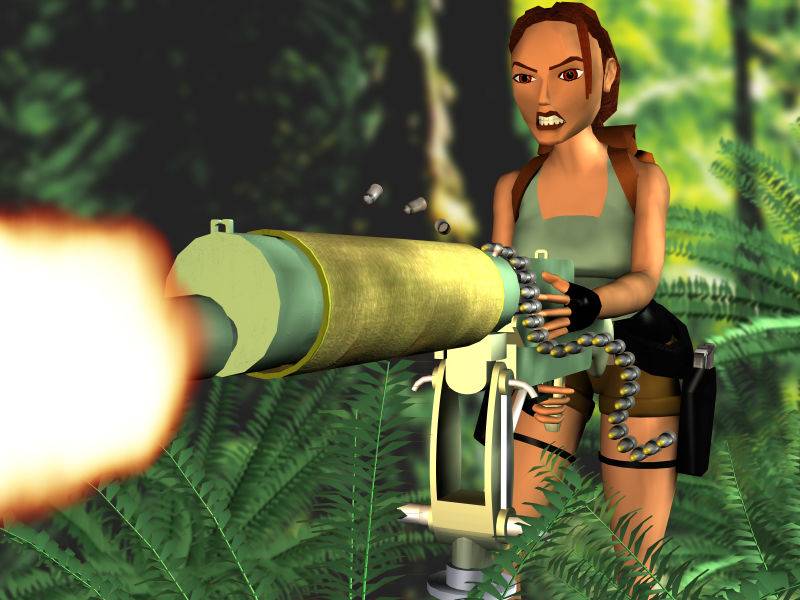
 Lara Croft is one of gaming's most enduring protagonists, up there with Mario and Master Chief. Created by Toby Gard at Core Design and introduced in the original Tomb Raider in 1996, she has been reinvented multiple times across nearly thirty years without ever losing the core of what makes her work. She is athletic, brilliant, British, and almost pathologically unwilling to stop moving forward regardless of what is in her way. Different eras of the franchise have emphasized different versions of her, but the character has survived every reinvention and remains one of the most recognizable names in gaming.
Lara Croft's Background and Origins
Lara was created as a deliberate counterpoint to the passive female characters common in games at the time. Toby Gard designed her as capable, independent, and in control of every situation she enters. The backstory established in the classic games gives her an aristocratic British upbringing, the daughter of Lord Richard Croft and Lady Amelia Croft. She attended Wimbledon High School and studied at the University of London before becoming a credentialed archaeologist. That combination of academic credibility and physical capability is what separates her from most action game protagonists. She does not stumble into adventure. She goes looking for it.
Classic Lara Croft (1996 to 2003)
The original Lara is confident, dry, and entirely comfortable with danger. She carries dual pistols, moves with precision through ancient ruins, and rarely breaks a sweat. There is a pulp adventure quality to the classic games that the character fits perfectly. She is not struggling to survive. She is enjoying herself. That version of Lara is polarizing because she can read as cold, but the coolness is the point. She is someone who has mastered her world and knows it. Angelina Jolie captured that version of the character well in the 2001 and 2003 films, bringing the physical confidence and slight detachment that defined classic Lara without softening her into someone warmer than the source material intended.
Crystal Dynamics Lara (2006 to 2008)
The Crystal Dynamics reboot beginning with Tomb Raider: Legend in 2006 kept most of the classic Lara's personality while adding a more personal emotional story. The Legend, Anniversary, and Underworld trilogy centered on Lara's search for her missing mother and gave her relationships that mattered beyond the artifacts she was chasing. Keeley Hawes voiced Lara across this era and the performance matched the classic confidence while adding warmth that the original games kept at arm's length.
Reboot Lara Croft (2013 to 2018)
The 2013 reboot was a deliberate reinvention. A young Lara, fresh out of university, shipwrecked on a mysterious island, fighting to survive against impossible odds. The influence of Uncharted is obvious and the game was upfront about it. This Lara is more vulnerable, more emotional, and more visibly affected by the violence around her. Camilla Luddington voiced the character across the reboot trilogy and the performance is strong, particularly in the quieter character moments. The reboot Lara divided fans of the classic character who felt the vulnerability undercut what made her iconic, but it brought new players to the franchise and the trilogy sold well. By Shadow of the Tomb Raider in 2018 the character had grown into something closer to the classic Lara, harder and more deliberate, suggesting the two versions were always meant to connect.
Lara Croft in Live Action
Lara Croft has been brought to screen three times across two separate film continuities, with a fourth interpretation on the way in the form of the Sophie Turner television series. Each version of the character reflects the era it was made in and the version of Lara the source material was emphasizing at the time.
Lara Croft: Tomb Raider (2001)
Directed by Simon West and released June 15, 2001, the first film follows Lara racing against a secret society called the Illuminati to recover the two halves of an ancient device called the Triangle of Light before a rare planetary alignment gives them the power to control time. Manfred Powell, played by Iain Glen, leads the Illuminati's efforts. Alex West, played by a then little-known Daniel Craig, is a rival archaeologist and complicated history for Lara. Her father Lord Richard Croft, played by Jon Voight, who is Jolie's real father, appears through flashbacks and gives the story its emotional center.
Angelina Jolie is the reason the film works. She has the physicality, the dry confidence, and the ability to make Lara's detachment feel like a superpower rather than a character flaw. She does not play Lara as someone trying to survive. She plays her as someone who is already winning and enjoying every minute of it. The film grossed $274 million worldwide and established Lara Croft as a viable film franchise.
Lara Croft Tomb Raider: The Cradle of Life (2003)
The sequel directed by Jan de Bont sends Lara after Pandora's Box before a biological weapons scientist named Jonathan Reiss, played by Ciarán Hinds, can use it to cause a global catastrophe. Gerard Butler plays Terry Sheridan, a former SAS soldier and ex-boyfriend of Lara's who betrayed his country and is given a chance at redemption by helping her. The dynamic between Jolie and Butler is one of the better things about the film and hints at a more interesting movie than the one surrounding it.
The Cradle of Life performed below the first film at the box office and received cooler reviews. The story is more generic and the film never quite finds the energy of its predecessor. A third Jolie film was discussed but never materialized, and the franchise went quiet for fifteen years.
Tomb Raider (2018)
Directed by Roar Uthaug and released March 16, 2018, the reboot stars Alicia Vikander as a young Lara who has never gone on an expedition, works as a bike courier in East London, and refuses to accept the inheritance from her missing father Lord Richard Croft, played by Dominic West. When she finally does claim it she discovers her father was researching the mythical Queen of Yamatai on a remote island, and she follows his trail there. Walton Goggins plays the villain Mathias Vogel, a mercenary holding the island under the control of a shadowy organization called Trinity. Daniel Wu plays Lu Ren, the sailor who helps Lara reach the island.
The film adapts the 2013 game origin story fairly directly and shares its strengths and weaknesses. Vikander's physical performance is strong and she commits fully to the survival horror tone of the early sections. The script is generic in places and the film leans heavily on the father-daughter story at the expense of letting Lara be interesting on her own terms. It grossed $274 million worldwide, identical to the first Jolie film, which is a coincidence worth noting. A sequel was in development with director Ben Wheatley attached but never moved forward, leaving Vikander's version of the character without a conclusion.
Lara Croft in Animation
The Netflix animated series Tomb Raider: The Legend of Lara Croft, released in 2023 and set after the reboot trilogy, received positive reviews and represented an interesting middle ground between classic and modern Lara. Hayley Atwell voiced the character and brought a dry wit that leaned toward the classic version while keeping the emotional depth of the reboot. A second season followed.
The Upcoming Tomb Raider TV Series
A live-action Tomb Raider television series written by Phoebe Waller-Bridge is in development with Sophie Turner cast as Lara Croft. Waller-Bridge's involvement is the most interesting creative signal the franchise has sent in years. Her sensibility, sharp, self-aware, and genuinely funny without sacrificing emotional weight, maps onto what a great Lara Croft story should feel like. Turner has the physicality and the dramatic range to handle the role. The combination is worth being interested in.
What Lara Croft Means to Gaming
Lara Croft appeared on the cover of magazines that had nothing to do with gaming in the late 1990s. She is one of the first gaming female icons. She had a Guinness World Record for most recognizable female video game character. She predates the mainstream conversation about female representation in games by decades and complicated it from the start, a capable and iconic female protagonist wrapped in a design that invited criticism. The conversation around her has never been simple and the franchise has never entirely resolved it. What has never been in question is that she works as a character. Nearly thirty years in, with new games, new films, and a new television series on the way, that much is settled.
